

Why Hire Local Contractors – Impact for Ontario Homes
Every homeowner in Oshawa and the Durham Region knows the challenge of finding a skilled contractor who truly understands local expectations and building rules. Whether you are planning a major renovation or building your dream home from the ground up, the contractor you choose can make all the difference in the project’s success and your property’s future value. This guide clarifies the vital role of licensed local contractors in Ontario and explains how their expertise ensures your home stands strong, safe, and compliant.
Table of Contents
- Defining Local Contractors and Their Role
- Types of Residential Construction Projects
- Local Knowledge: Codes and Climate
- Relationships With Suppliers and Subtrades
- Financial, Legal, and Permit Considerations
- Risks of Non-Local Contractors Compared
Key Takeaways
| Point | Details |
|---|---|
| Importance of Local Contractors | Local contractors in Ontario are vital for managing residential construction, ensuring compliance with provincial regulations and safety standards. |
| Diverse Project Types | Ontario’s residential construction includes various projects, such as single-family homes and affordable housing, to meet community needs. |
| Building Codes and Climate | Understanding the Ontario Building Code and local climate challenges is essential for effective construction practices and project success. |
| Risks of Non-Local Contractors | Hiring non-local contractors may lead to compliance issues, logistical challenges, and potential project delays due to their unfamiliarity with local standards. |
Defining Local Contractors and Their Role
In Ontario, local contractors play a critical role in residential construction and renovation projects, serving as skilled professionals who transform homeowner visions into reality. Local contractors in Ontario are licensed professionals responsible for executing construction work with precision, expertise, and compliance with provincial regulations.
Under the Occupational Health and Safety Act, a local contractor is legally defined as the primary entity responsible for managing and executing construction projects. These professionals hold significant accountability, ensuring all work meets stringent provincial standards and safety requirements. Constructor guidelines mandate that local contractors must coordinate multiple aspects of a project, including workforce management, safety protocols, and regulatory compliance.
Local contractors bring substantial value to Ontario homeowners through their deep understanding of regional building codes, climate considerations, and municipal regulations. They provide comprehensive services ranging from initial project planning to final construction, managing everything from architectural design to material selection and implementation. Their local expertise means they understand specific environmental challenges unique to Ontario’s diverse geographic regions, from urban Toronto settings to rural Northern communities.
Pro tip: Always verify a local contractor’s licensing status through the Home Construction Regulatory Authority before beginning any renovation or construction project.
Types of Residential Construction Projects
Residential construction in Ontario encompasses a diverse range of project types designed to meet the evolving housing needs of communities across the province. Residential construction projects vary widely, addressing different demographic requirements and housing market demands.
The primary categories of residential construction projects include single-family homes, multi-unit residential buildings, additions, renovations, and secondary dwelling units. Single-family homes remain the most traditional form of residential construction, typically featuring standalone structures on individual lots. Multi-unit residential buildings, such as apartment complexes and condominiums, represent another significant sector that addresses urban housing density and affordability challenges.
Ontario’s residential construction landscape also includes specialized project types like affordable housing developments and adaptive reuse projects. Building more homes involves strategic approaches that consider not just construction techniques, but also broader community needs. These projects range from small-scale home improvements to large infrastructure developments aimed at creating sustainable, accessible housing solutions for diverse population groups.
Below is a quick reference guide to common residential construction project types in Ontario:
| Project Type | Typical Purpose | Common Features |
|---|---|---|
| Single-Family Home | Private residence for one family | Detached, individual lots |
| Multi-Unit Residential | Urban density and affordability | Apartments or condominiums |
| Secondary Dwelling Unit | Additional on-property living | Basement suites, garden homes |
| Adaptive Reuse | Repurpose existing buildings | Converts old structures |
| Affordable Housing Development | Increase accessibility | Subsidized units, mixed-tenure |
Pro tip: Before starting any residential construction project, carefully research local zoning regulations and obtain necessary municipal permits to ensure compliance and avoid potential legal complications.
Local Knowledge: Codes and Climate
Ontario’s residential construction landscape is uniquely shaped by complex regulatory requirements and challenging environmental conditions that demand specialized local expertise. Ontario Building Code regulations represent a comprehensive framework that ensures construction projects meet rigorous safety, efficiency, and performance standards specific to the province’s diverse geographic regions.
Local contractors must navigate an intricate set of building requirements that account for Ontario’s distinct climatic challenges. These include designing structures capable of withstanding extreme temperature variations, heavy snowfall, seasonal humidity fluctuations, and potential severe weather events. Climate-resilient building design has become increasingly critical, with modern construction practices incorporating advanced techniques that anticipate potential environmental shifts and long-term climate trends.
The provincial building standards go far beyond basic structural requirements, encompassing energy efficiency, accessibility, sustainable design, and regional environmental considerations. Contractors must demonstrate deep understanding of local microclimates, soil conditions, drainage patterns, and geological characteristics unique to specific Ontario communities. This localized knowledge ensures that residential construction projects are not just compliant with regulations, but also optimized for performance, durability, and occupant comfort across different geographical contexts.
Pro tip: Consult local municipal building departments and professional engineering associations to stay current on the most recent climate-adaptive construction techniques and regulatory updates.
Relationships With Suppliers and Subtrades
In the complex world of residential construction, contractor-subtrade relationships form the backbone of successful project execution. These intricate partnerships require careful management, strategic communication, and a deep understanding of each trade’s specialized expertise and operational nuances.
General contractors in Ontario must cultivate robust networks of trusted subcontractors who bring specialized skills to different phases of construction. These relationships extend beyond simple transactional interactions, involving comprehensive coordination of technical capabilities, scheduling, quality standards, and safety protocols. Legal agreements with subcontractors play a critical role in defining expectations, establishing clear performance benchmarks, and mitigating potential disputes that could derail project timelines.
Successful supplier and subtrade relationships are built on mutual respect, transparent communication, and a shared commitment to delivering high-quality residential construction outcomes. Local contractors must continuously evaluate and nurture these professional connections, understanding that the strength of their network directly influences project efficiency, cost-effectiveness, and overall client satisfaction. This involves maintaining rigorous selection criteria, providing consistent feedback, ensuring timely payments, and creating an environment of collaborative problem-solving.
Pro tip: Develop a comprehensive vendor management system that tracks subcontractor performance, certifications, and reliability to continuously improve your professional network.
Financial, Legal, and Permit Considerations
Navigating the complex landscape of residential construction requires a comprehensive understanding of Ontario’s Construction Act amendments and regulatory frameworks. Contractors and homeowners must carefully manage financial arrangements, legal obligations, and regulatory compliance to ensure smooth project execution and protect their respective interests.
The permit acquisition process represents a critical initial step in any residential construction project. Building permit requirements are mandatory and serve as a crucial mechanism for ensuring that construction projects meet provincial safety, accessibility, and environmental standards. These permits involve detailed documentation, comprehensive plan reviews, and municipal inspections that validate the proposed work’s compliance with established building codes and zoning regulations.
Financial considerations extend beyond initial project budgeting, encompassing complex legal mechanisms such as payment schedules, holdback provisions, and potential dispute resolution processes. Contractors must develop robust financial management strategies that account for prompt payment requirements, potential liens, and the intricate cash flow dynamics inherent in residential construction projects. Understanding these financial and legal nuances helps mitigate risks, protect investment, and maintain positive relationships between all project stakeholders.
Pro tip: Consult with a legal professional specializing in construction law to develop comprehensive contract templates that clearly define payment terms, scope of work, and potential contingencies.
Risks of Non-Local Contractors Compared
Hiring non-local contractors introduces significant challenges that can compromise the overall quality and reliability of residential construction projects in Ontario. Construction contract risks emerge from complex logistical and regulatory hurdles that may not be immediately apparent to homeowners seeking cost-effective solutions.
One primary concern involves regulatory compliance and deep understanding of provincial building standards. Non-local contractors may lack comprehensive knowledge of Ontario’s specific building codes, climate considerations, and municipal regulations. Licensing requirements become particularly critical, as out-of-province contractors might not possess the necessary certifications or understand the nuanced local regulatory landscape. This knowledge gap can result in potential code violations, increased project complexity, and potential financial risks for homeowners.
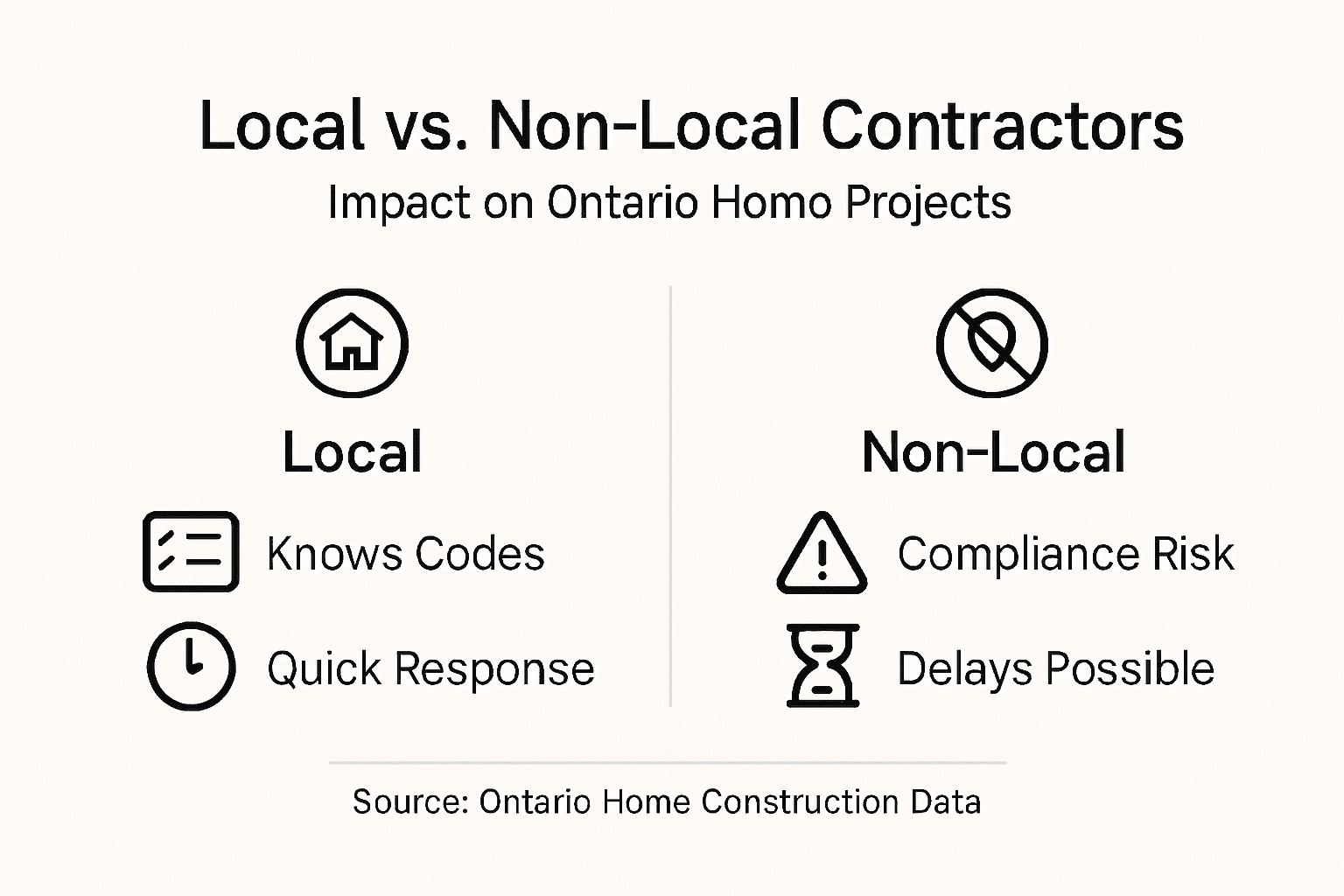
Additionally, non-local contractors face inherent challenges related to regional adaptation, workforce management, and supply chain logistics. Labour shortages and unfamiliarity with local construction environments can lead to communication breakdowns, extended project timelines, and potential quality inconsistencies. Local contractors, by contrast, leverage established regional networks, understand specific environmental constraints, and can navigate municipal requirements with greater efficiency and precision.
Here’s a summary of key differences between local and non-local contractors in Ontario:
| Aspect | Local Contractor Advantages | Non-Local Contractor Risks |
|---|---|---|
| Regulatory Knowledge | Strong familiarity with Ontario codes | May overlook provincial regulations |
| Climate Expertise | Designs suited to Ontario’s climate | May not adapt to local weather challenges |
| Network Access | Strong supplier and subtrade relationships | Limited local supply chain presence |
| Project Efficiency | Faster permit and schedule management | Higher risk of delays and miscommunication |
| Certification | Holds necessary local licences | May lack proper credentials for Ontario |
Pro tip: Request comprehensive documentation of a non-local contractor’s provincial certifications, recent local project experience, and references from Ontario-based clients before finalizing any agreements.
Choose Local Expertise for Your Ontario Home Project
Understanding the challenges presented by non-local contractors such as unfamiliarity with Ontario’s building codes, climate conditions, and supply chain limitations is critical to ensuring your home construction or renovation meets the highest standards. At Henley Contracting, we specialize in delivering tailored solutions with deep local knowledge and trusted partnerships that guarantee compliance, quality craftsmanship, and efficient project execution from start to finish.
Our team has been serving communities across Durham, Kawartha Lakes, and Northumberland County for over three decades offering comprehensive services including Custom Build and Renovations that align with your vision and Ontario’s unique regulatory environment.

Ready to secure a reliable local contractor who understands the nuances of Ontario’s residential construction? Contact us today at Henley Contracting and experience peace of mind knowing your home is built by professionals dedicated to quality, safety, and your satisfaction.
Frequently Asked Questions
What are the benefits of hiring local contractors for home construction?
Hiring local contractors ensures compliance with regional building codes, better understanding of local climate conditions, and quicker access to necessary permits and supplies, leading to more efficient project execution.
How do local contractors understand building codes and regulations?
Local contractors are well-versed in the specific building codes and regulations of their area due to their experience and continuous engagement with local authorities, ensuring projects meet safety and compliance standards.
What types of residential projects can local contractors handle?
Local contractors can manage a range of residential projects including single-family homes, multi-unit residential buildings, renovations, additions, and secondary dwelling units, offering expertise tailored to each type of construction.
Why is it risky to hire non-local contractors?
Hiring non-local contractors can lead to potential issues with regulatory compliance, misunderstanding of local climate challenges, and logistical problems, which may ultimately cause delays, increased costs, and quality inconsistencies.